
I HEAR YOU
If Sawubona invited us to truly see another person, the natural next step in meeting your people where they are is to improve how you listen — to truly hear them.
In our high-stakes, fast-paced environments, we tend to arrive with urgency: to have answers, to fix, to decide. It can feel like Family Feud with everyone racing to smack the buzzer.
I hear you is about listening to understand rather than listening to respond or react. This intentional act requires practice — practice in slowing down, quieting the noise, and resisting the temptation to prove how smart you are by answering before they even finish speaking.
There is a real pause in this work. Sometimes an awkward one. And because it’s unexpected when first practiced, it can feel uncomfortable.
But that pause — and the understanding that follows — can measurably impact trust, employee engagement, and ultimately, organizational health.
Why listening matters now more than ever
Emerging workplace research shows that active listening isn’t just a “nice-to-have” soft skill. The World Economic Forum’s Future of Jobs Report identifies empathy and active listening among the essential leadership skills needed through 2030 and beyond, noting their role in building trust, improving problem solving, enhancing leadership, and increasing productivity.[i]
You could shrug this off and focus solely on rapid advances in AI and big data. But while many skills — reasoning, communication, coordination — will be automated, high-quality human connection will not. The ability to pause, see, and hear people may well become the greatest competitive advantage organizations possess.
Active Listening: how to become a better listener
According to the Center for Creative Leadership, active listening goes beyond simply hearing words.[ii] A few practices to bring into your daily leadership:
1. Listen to understand, not to reply
Hold your response. Reflect back what you heard before offering advice. This slows the reflex to fix and communicates respect for the speaker’s experience.
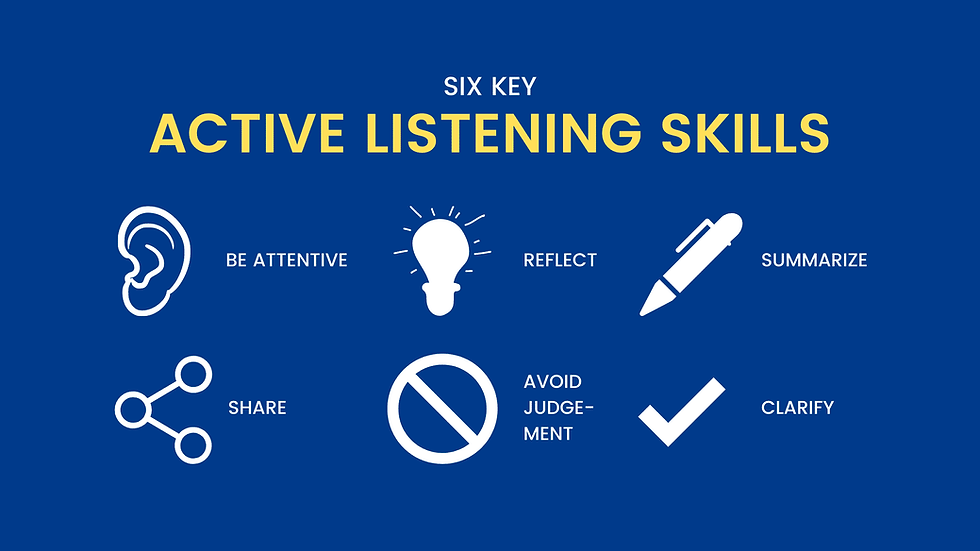
2. Use active listening techniques
Practice:
· withholding judgment
· reflecting and paraphrasing
· asking clarifying, open-ended questions
· summarizing key points before responding
These techniques deepen understanding and signal that the speaker is truly heard.
3. Model empathy through presence
Empathy isn’t just acknowledging emotion; it’s engaging with it thoughtfully. Pairing listening with curiosity helps leaders uncover needs and perspectives that might otherwise go unspoken.
4. Take intentional follow-up action
Research shows employees feel twice as listened to when leaders act on what they hear — not just acknowledge it. Action reinforces trust and builds psychological safety.
Reflection questions to deepen your practice
To help you think more critically about how you apply these skills, here are some reflection questions from Carey Musburger’s article Empathy and Active Listening[iii]:
How well do you respond to others’ feelings and needs?
Do you take the time to recognize emotions and respond with understanding, or do you focus solely on solutions?
Do you seek constructive feedback from those you interact with regularly?
How often do you ask others how well you listen, and what improvements can be made?
How often does your mind drift during conversations?
Are you fully present, or do distractions and multitasking affect your ability to truly listen?
Do you know someone you’d classify as a “good listener”?
What do they do that makes you feel heard and valued? Think about how you can adopt some of these behaviors.
In addition to the above, I challenge you to try to slow your heart beat and breathing down intentionally as you work to be fully present with the person. I use the word “work” because this is an intentional practice. I believe you will find that these actions with help you as a leader to build trust, reinforce psychological safety and establish stronger relationships that can allow you to manage the tougher stuff like conflict and problem solving.
Sawubona + Active Listening = Transformational Leadership
In a world where information flows rapidly and attention is scarce, leaders who listen deeply create differentiated value. They foster cultures where people feel respected, understood, and engaged—conditions that strengthen performance, creativity, and resilience.
Seeing another human being begins the work—listening with presence, empathy, and discipline is how leadership becomes transformational.
[i] World Economic Forum. Future of Jobs Report 2023. World Economic Forum, 2023. https://www3.weforum.org/docs/WEF_Future_of_Jobs_2023.pdf Accessed 31 Dec. 2025
[ii] Center for Creative Leadership. “Active Listening: Best Practices for Leaders.” CCL, 1 Sept. 2025, https://www.ccl.org/articles/leading-effectively-articles/coaching-others-use-active-listening-skills/ Accessed 31 Dec. 2025
[iii] Musburger, Carey. Empathy and Active Listening – Essential Skills for the Future of Work. Human Resource Services, Washington State University, 1 Oct. 2024, https://hrs.wsu.edu/empathy-and-active-listening-essential-skills-for-the-future-of-work/. Accessed 6 Jan. 2026

Comments